
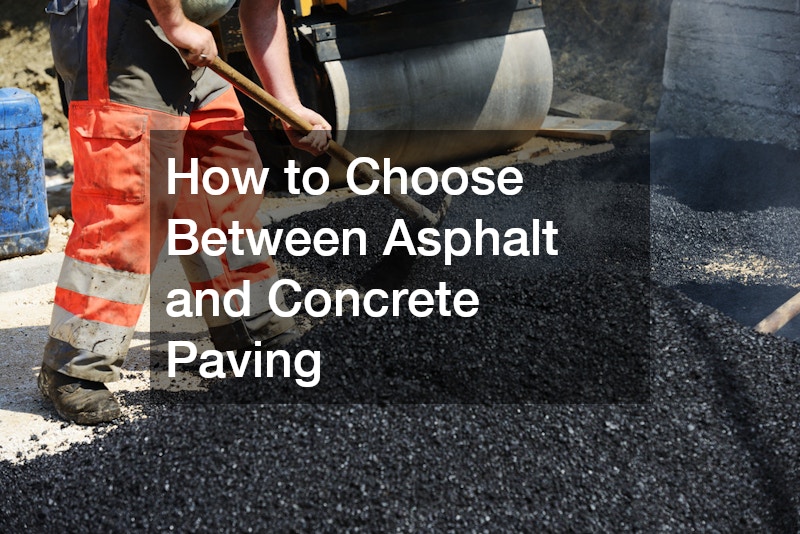
When you approach a residential or commercial property, the surface you drive and walk on sets the immediate tone for the entire location. A driveway or a commercial parking area is far more than just a utilitarian place to park your vehicles—it is a massive structural investment that drastically impacts your property’s curb appeal, overall real estate value, and daily safety. Despite its importance, the decision of which material to use is frequently misunderstood or glossed over by property owners.
Often, property owners find themselves paralyzed by the choice between traditional blacktop and rigid cement. Many make the mistake of making their final decision based purely on aesthetics or a neighbor’s recommendation, without considering the unique variables of their own property. Making the wrong decision—failing to account for your local climate, the specific traffic loads the area will endure, and your personal bandwidth for ongoing maintenance—can lead to disastrous results. A surface chosen poorly will crack, heave, or crumble prematurely, turning a significant financial investment into an ongoing, expensive nightmare.
This comprehensive guide is designed to eliminate the guesswork and provide you with a clear, analytical framework for making the best decision for your property. We will break down the exact criteria you must evaluate: initial financial budgets, regional weather variables, load-bearing capacities, and long-term maintenance schedules. By understanding the distinct engineering strengths and weaknesses of both materials, you can make an educated, lasting decision that will serve your property well for decades to come.
Calculate Initial Costs and Curing Times Before Making a Decision

The absolute first step in your decision-making process should be a practical evaluation of your immediate budget and your timeline for usability. Grab a tape measure, head outside, and calculate the total square footage of the area you intend to pave. Having this number in hand will allow you to understand the dramatic financial difference between the two primary materials before you ever speak to a professional.
When comparing upfront installation costs, the financial breakdown strongly favors blacktop. As a petroleum-based product mixed with stone aggregate, this material is generally much cheaper to produce and install per square foot. For homeowners with massively long, winding rural driveways, or business owners looking to cover a sprawling commercial lot, the cost difference can amount to tens of thousands of dollars. Hiring a specialized asphalt paving company is often the most budget-friendly way to quickly lay down a vast expanse of new, highly functional surface without entirely depleting your improvement budget.
Beyond the immediate out-of-pocket expense, you must factor in the speed of usability. Time is a critical currency, especially for commercial properties that cannot afford to shut down their entrances for weeks at a time. Blacktop is prized for its rapid turnaround. Because it cures through cooling rather than a chemical reaction, a newly laid blacktop surface can typically be driven on within 48 to 72 hours of installation. Many providers offer comprehensive asphalt services that include not only the rapid installation of the base and top layers but also immediate line striping and finishing, minimizing the disruption to a busy home or active business.
In stark contrast, cement requires a significantly larger upfront investment—often costing anywhere from forty to sixty percent more per square foot than its petroleum counterpart. Furthermore, it demands patience. Cement does not dry; it cures through a prolonged chemical process called hydration. While you may be able to walk on a newly poured slab within a day or two, it generally takes up to a full week of curing before it possesses the compressive strength required to bear the weight of a standard passenger vehicle, and up to a month to reach its maximum hardness. If you cannot afford to park on the street for a week, this time delay is a major factor to consider.
Factor in Ongoing Upkeep Requirements and DIY Feasibility

While the initial installation price is a crucial starting point, the true cost of any structural surface is measured over its entire lifespan. You must realistically assess your willingness, ability, and budget to perform preventative maintenance over the next ten to twenty years. The ongoing upkeep required for these two materials could not be more different, and choosing a material that does not align with your maintenance habits will guarantee premature failure.
Cement is largely considered a “set it and forget it” material. Aside from the occasional application of a penetrating sealant every few years to protect against chemical stains, and routine power washing to remove dirt and organic growth, a properly poured slab requires very little active intervention. If the expansion joints are kept clear of weeds and occasionally topped off with flexible caulking, the surface will essentially take care of itself for decades.
Blacktop, however, is a highly dynamic, flexible material that demands a strict, proactive maintenance regimen. The petroleum binders that give the material its dark color and flexibility are highly susceptible to ultraviolet degradation. Over time, the sun literally bakes the essential oils out of the surface. As the surface dries out, it transforms from a rich, flexible black surface to a brittle, faded gray one. Once it becomes brittle, it loses its ability to flex under the weight of vehicles, leading directly to surface cracking and structural deterioration.
To prevent this, property owners must commit to applying liquid sealers every two to three years to replenish those essential oils and provide a protective barrier against water and UV rays. While some homeowners attempt this as a DIY project, it is highly recommended to seek professional help. Using cheap buckets of sealer from a local hardware store rarely offers the same longevity as the commercial-grade emulsions used by dedicated sealcoating companies, who possess the specialized spray rigs necessary for an even, heavy-duty application.
Even with meticulous care, heavily trafficked commercial areas will eventually wear down. Decades of heavy use and sun exposure will degrade the top layer beyond what a simple liquid sealer can fix. In these instances, properties will require full parking lot resurfacing, a process where massive milling machines grind off the top one to two inches of degraded material, allowing crews to lay down a fresh, perfectly smooth topcoat without having to excavate the entire sub-base.
Match Your Material to Extreme Temperature Swings

No matter how large your budget is or how diligently you maintain your property, you cannot out-engineer Mother Nature. The specific regional climate in which you live is arguably the most critical factor in determining which material will survive the longest. Before making a final choice, research your local climate data, focusing heavily on the frequency of hard freezes during the winter and the number of days your area experiences temperatures over ninety degrees Fahrenheit.
Cement thrives in environments defined by extreme, unrelenting heat. Because of its light gray color, it naturally reflects a significant portion of the sun’s radiant energy, remaining relatively cool to the touch and structurally completely rigid even during historic heatwaves. However, it has a fatal weakness in the cold. Because it is a completely rigid material with zero flexibility, it cannot tolerate the extreme expansion and contraction of the earth beneath it. In northern climates, water seeps into the ground and freezes. As that water turns to ice, it expands, pushing the soil upward in a phenomenon known as frost heave. This immense upward pressure will effortlessly snap and crack a rigid slab.
Blacktop possesses the exact opposite thermodynamic properties. Its dark color acts as a massive solar sponge, absorbing heat from the sun. In northern climates, this is a phenomenal advantage, as the surface will actively melt snow and ice much faster than surrounding areas, keeping driveways clear and safe. More importantly, its petroleum base gives it a degree of flexibility. When frost heaves occur, the surface can slightly bend and flex with the shifting earth without snapping. However, this same flexibility becomes a severe liability in the deep South. In sustained, extreme heat, the surface can soften, become sticky, and easily deform under pressure.
Consulting with a highly experienced local paving contractor is the best way to understand which material historically survives the longest in your specific zip code. These professionals see firsthand how different materials react to the micro-climates in your region. A reputable paving company will not just use a one-size-fits-all approach; they will actively adjust their chemical mix and aggregate ratios based on the current season and your region’s historical temperature swings to ensure the surface achieves maximum durability.
Weigh the Impact of Heavy Vehicles and Daily Wear
Beyond the weather, you must objectively audit the type of physical stress your new surface will endure on a daily basis. The weight, frequency, and type of vehicles that will use the area dictate the required tensile and compressive strength of your chosen material. If your surface will only ever see lightweight passenger sedans moving in and out of a garage, your options are wide open. However, if you plan to park heavy recreational vehicles, host commercial delivery trucks, or place massive, steel-wheeled waste bins on the surface, you must adjust your material choice accordingly.
The key to understanding load-bearing capacity lies in the difference between moving weight and static weight. When a vehicle is driving over a surface, the weight is distributed and transient. But when a vehicle parks, that weight becomes a localized, static load pressing down on a small footprint for hours, days, or months at a time.
Cement is an incredibly dense, rigid material that boasts phenomenal compressive strength. It will not deform, indent, or rut under immense static loads. This makes it the undisputed champion for properties that host heavy, stationary objects. If you plan to park a 15,000-pound motorhome in the same spot all winter, or if you run a business that receives daily shipments from dual-axle commercial freight trucks, a dedicated concrete company can pour a specialized, extra-thick pad specifically designed to bear that extreme weight without flinching. To further ensure the slab never fails, skilled concrete contractors will construct a grid of heavy-duty steel rebar or thick wire mesh within the wooden forms before the pour. This internal skeleton exponentially increases the slab’s tensile strength, preventing structural failure and cracking even under the most punishing industrial conditions.
Blacktop, due to its inherent flexibility, struggles with heavy static loads. If you park a boat trailer with a heavy tongue jack, a motorcycle with a narrow kickstand, or a massive RV on a blacktop surface—especially during the heat of the summer when the material is softened by the sun—those pressure points will sink deeply into the surface. Over time, these static loads create permanent, deep ruts and divots that collect water, breed potholes, and permanently ruin the structural integrity of the driveway.
Demand Portfolio Proof and Verify Proper Subgrade Preparation
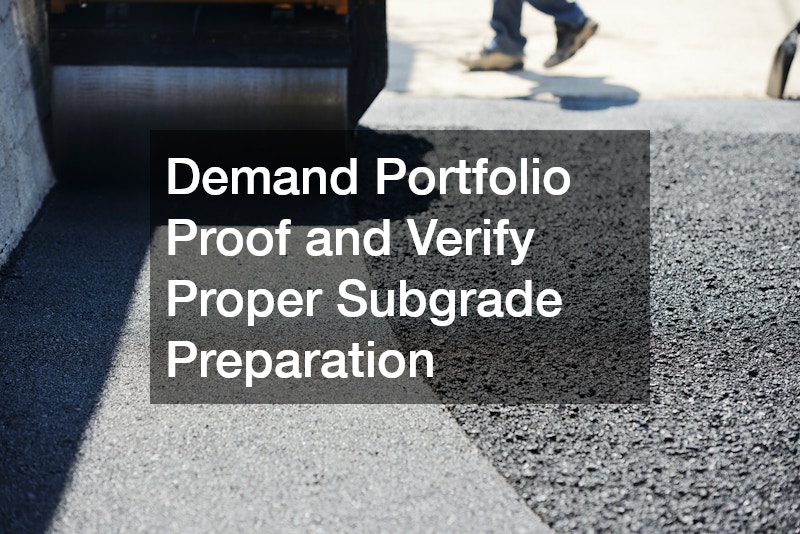
Once you have analyzed your budget, weather, and weight requirements and decided on the perfect material for your property, the final and most important step is selecting the right professionals to execute the vision. The harsh reality of the construction industry is that the surface you see is only as good as the foundation you cannot see. A beautifully finished surface poured or rolled over a thin, poorly prepared dirt base will inevitably fail, crack, or collapse within a single year.
When interviewing professionals, you must explicitly ask about their subgrade preparation process. The subgrade is the excavated earth and the layer of crushed aggregate gravel that sits directly beneath the final paved surface. This hidden layer is responsible for bearing the load of the vehicles and directing water away from the structure. A proper installation requires aggressive mechanical compaction using heavy vibratory rollers to ensure the gravel base is entirely locked together and will not settle over time. Furthermore, the contractor must use laser levels to ensure the subgrade is perfectly sloped to direct stormwater runoff away from your home’s foundation and toward municipal drainage systems.
Provide yourself with a strict checklist for vetting professionals. You should always obtain at least three fully itemized quotes from different paving contractors. Do not just look at the final bottom-line price; look at the specifics of what they are offering. Compare exactly how many inches of crushed gravel base they are installing, how many inches of top-coat thickness they guarantee, and what type of drainage solutions they propose.
It is incredibly tempting to jump at the lowest price, but this is often a fatal error. A cheap concrete driveway contractor might submit a lowball bid by cutting invisible corners—such as pouring a three-inch slab when a four-inch slab is required, skipping the crucial wire mesh reinforcement grid to save on steel costs, or failing to properly compact the sub-base. Always demand to see a portfolio of their completed local projects, specifically asking for addresses of driveways they completed three to five years ago so you can drive by and see how their work holds up over time. Finally, refuse to sign any agreement that does not include a robust, written warranty covering structural cracking, premature crumbling, or severe water pooling.
Making the choice between these two foundational materials does not have to be an overwhelming process. By systematically evaluating your specific needs, the decision usually reveals itself. If you require a lower upfront cost, live in a colder climate prone to freezing, and prefer a flexible material that can be easily repaired and resurfaced, blacktop is likely your best route. If your priority is extreme longevity, you live in a hot climate, or you need a surface capable of withstanding the immense static weight of heavy vehicles without deformation, a rigid cement slab is the superior investment.
Ultimately, remember that regardless of the material you select, the lifespan of your driveway or parking lot relies entirely on the quality of the initial installation and your ongoing commitment to proactive maintenance. A highly expensive material installed poorly will fail faster than a budget material installed perfectly.
Take a walk around your property today. Measure your available space, critically evaluate your climate and vehicle needs, and begin reaching out to highly-rated local professionals to schedule your on-site estimates.